Audacity by Jonathan Chait
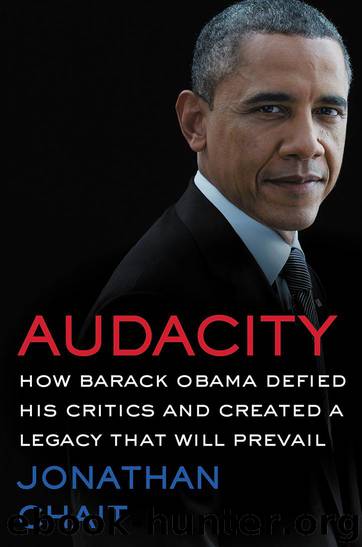
Author:Jonathan Chait
Language: eng
Format: mobi, epub, azw3
Publisher: HarperCollins
Published: 2017-01-16T21:00:00+00:00
CHAPTER 5
To Stanch a Bleeding World
On October 9, 2009, the Nobel Committee announced it had awarded its Nobel Peace Prize to Barack Obama, who had not yet completed his ninth month as president. The committee’s choice astonished and even embarrassed the Obama administration, which had barely settled into office. The committee’s unusual reasoning credited Obama anyway, for what might be more accurately described as goals rather than accomplishments: he had “created a new climate in international politics,” taking care to mention such feats as, “Multilateral diplomacy has regained a central position,” and, “Democracy and human rights are to be strengthened” (which is far from boasting that they actually had been strengthened). This was a peculiar basis for bestowing such a prestigious award. Multilateral diplomacy had been a hallmark of American diplomacy for decades, until the administration immediately preceding Obama’s. And “creating a new climate in international politics” meant, mostly, restoring the climate that had existed until 2001. In other words, Obama had been awarded the Nobel Prize for the achievement of not being George W. Bush.
The contrast between Obama’s approach to handling world affairs and that of his predecessor did not merely dominate his foreign policy at the outset of his presidency—it defined it throughout. This can be seen as an indictment of Obama’s strategy, or a defense—or, to some extent, both. Just as Obama’s economic policy was initially dominated by the need to recover from an emergency inherited by his predecessor, so too did inherited conditions determine the course he set in world affairs. The Bush administration had let loose a chaotic failed state in the Middle East at the cost of thousands of American casualties and hundreds of billions of dollars while diminishing America’s standing throughout the world. Obama’s task required a corrective effort, a restoration of the (usually sober) internationalist traditions that had defined American policy for decades, from the end of World War II to Bush.
It is easier to make a provisional judgment of domestic policy than foreign policy. The Truman administration’s strategy of containing the Soviet Union absorbed bitter criticism from left and right, and its full success could only be judged four decades later, when the Soviet bloc crumbled (confounding predictions of the hawks who demanded aggressive rollback as the only solution) without starting World War III (as anti–Cold War doves claimed it would). Numerous heavy-handed American interventions in the developing world seemed to yield short-term success while seeding resentment and blowback whose costs would not become fully apparent for years to come. Still, a rough judgment can be cautiously ventured. Unlike his approach to domestic policy and politics, Obama’s foreign policy was not transformative. Obama slowed the bleeding of the Bush years but never fully stanched it. This negative quality of Obama’s foreign policy strategy—the way in which his non-Bushness overshadowed any positive characteristics—provides the key to understanding both its virtues and its limits.
* * *
As he rocketed onto the national stage as a first-term senator, Obama needed to present himself as a plausibly seasoned statesman.
Download
This site does not store any files on its server. We only index and link to content provided by other sites. Please contact the content providers to delete copyright contents if any and email us, we'll remove relevant links or contents immediately.
| Anthropology | Archaeology |
| Philosophy | Politics & Government |
| Social Sciences | Sociology |
| Women's Studies |
The Secret History by Donna Tartt(18988)
The Social Justice Warrior Handbook by Lisa De Pasquale(12175)
Thirteen Reasons Why by Jay Asher(8868)
This Is How You Lose Her by Junot Diaz(6853)
Weapons of Math Destruction by Cathy O'Neil(6242)
Zero to One by Peter Thiel(5756)
Beartown by Fredrik Backman(5702)
The Myth of the Strong Leader by Archie Brown(5479)
The Fire Next Time by James Baldwin(5405)
How Democracies Die by Steven Levitsky & Daniel Ziblatt(5193)
Promise Me, Dad by Joe Biden(5125)
Stone's Rules by Roger Stone(5062)
A Higher Loyalty: Truth, Lies, and Leadership by James Comey(4936)
100 Deadly Skills by Clint Emerson(4898)
Rise and Kill First by Ronen Bergman(4752)
Secrecy World by Jake Bernstein(4721)
The David Icke Guide to the Global Conspiracy (and how to end it) by David Icke(4670)
The Farm by Tom Rob Smith(4482)
The Doomsday Machine by Daniel Ellsberg(4467)
